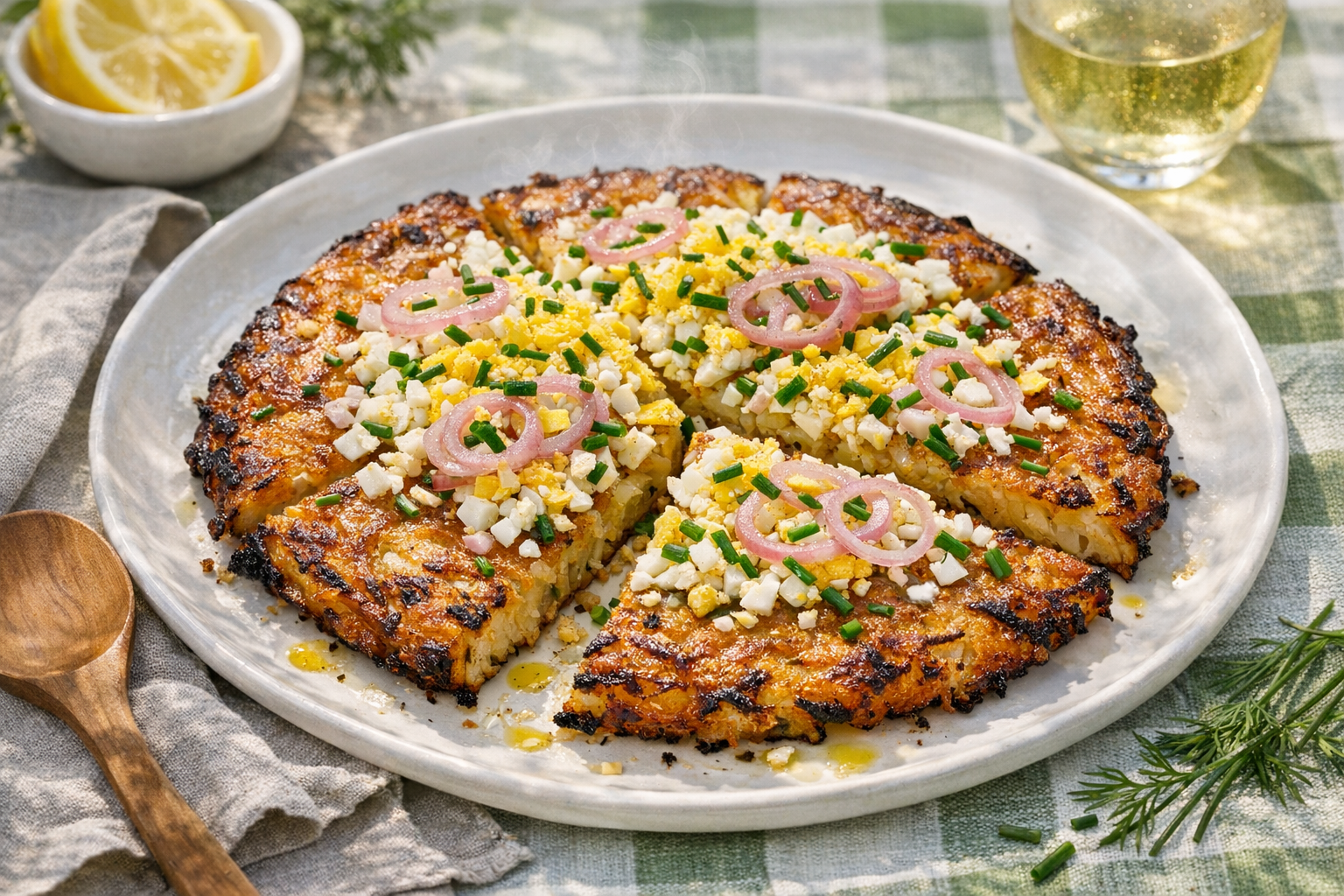
Chilled Rosti With Egg Mimosa
Cool and composed, this pan-seared rosti is left to settle before being veiled in a classic egg mimosa and a flicker of sharp shallot. It eats like a calm reply to a tense day: crisp giving way to tender potato, creamy egg, and vinegared brightness, all served cold.
Rosti began as a borderland staple, cooked in wide pans on Alpine farms before slipping across Swiss cantons into neighboring kitchens, a quiet testament to exchange over enclosure. The Belle Epoque spread the "mimosa" garnish through grand hotels and railway cafes, where grated yolks crowned cold dishes for travelers moving with new speed. Here in July, Belgian new potatoes, chives, and shallots meet those traditions in a dish that cools deliberately before serving, its restraint nodding to an era when salons valued poise even as power jostled beneath the surface. The golden rosti hints at the pull between open sharing and tight control, while the tidy shower of yolk mirrors the tidy ledgers of modern campaigns. Even Maine's potato fields-long tied to livelihoods and politics-ghost the plate, reminding us how humble staples underwrite larger contests. The result is familiar yet slightly guarded: a border-walking classic, arranged with care. Inspired by Silicon Valley Splits Over Closing the Borders to Chinese A.I. and After Democratic Shake-Up, Susan Collins Holds Enormous Cash Edge in Maine.
To drink: Pour a dry Belgian saison, lightly chilled; its peppery, citrusy lift cuts through the creamy egg and buttery potato while keeping the finish refreshing.
Why this dish?
Menu slot: Saturday Project
Today's draw: eggs · pan-searing · potatoes · Cold dish · historical connection
Front-page mood: tense and foreboding
Why this concept: Unlike recent seafood, grain, and flatbread features, the rösti-with-egg-mimosa is a cold, potato-based skillet dish that centers eggs without extra proteins; its crisp-cool contrast and Belle Époque nod make it structurally and thematically unique.
Drawn from:
- Silicon Valley Splits Over Closing the Borders to Chinese A.I.
- After Democratic Shake-Up, Susan Collins Holds Enormous Cash Edge in Maine

Instructions
- Set up: place a wire rack over a baking tray for cooling, and prepare a medium bowl of ice water for the eggs.
- Quick-pickle the shallot: in a small saucepan, heat the vinegar, water, honey, and 1.5g salt over medium until steaming and the salt dissolves, 1-2 minutes. Pour over the sliced shallots in a heatproof bowl, press to submerge, and let stand 20-30 minutes, stirring once; cool to room temperature.
- Cook the eggs: place eggs in a saucepan, cover with cold water by 3 cm, bring to a boil over medium-high heat, then reduce to a gentle simmer and cook 9 minutes. Drain and chill in the ice bath for 10 minutes; set aside.
- Prepare the potatoes: peel and coarsely grate the potatoes. Sprinkle with 5g of the salt, toss, and let stand 5 minutes to draw moisture. Squeeze by the handful in a clean towel until very dry; fluff the shreds.
- Pan-sear the rosti, side one: heat a 28-30 cm nonstick or cast-iron skillet over medium-high. Add 15 ml oil and 20 g butter; when the butter foams, add the potatoes and press into an even 1.3-1.5 cm layer. Cook 12-14 minutes, adjusting to medium if browning too quickly, until the edges are deeply golden and the sizzle is steady.
- Flip and finish: slide the rosti onto a plate. Return the pan to medium-high, add the remaining 15 ml oil and 20 g butter, then invert the rosti back into the pan. Cook 10-12 minutes, until a skewer meets little resistance in the center and the underside is evenly golden.
- Season and cool: transfer the rosti to the rack. Sprinkle over the remaining 1g salt and all the pepper. Let cool 20 minutes; carryover heat will finish softening the center while the surface firms and crisps. If the kitchen is warm, refrigerate 10 minutes to serve fully cold.
- Make the egg mimosa: peel the eggs. Separate yolks and whites; finely chop the whites. Grate the yolks on a fine grater or press through a sieve. In a bowl, fold the chopped whites with the mayonnaise, Dijon, cornichons, parsley, and 10 g of the chives (reserve the rest). Season with 2.5 g salt and 0.5 g pepper. Chill 10 minutes to set.
- Drain the shallots well and pat dry with paper towels so they do not weep onto the rosti.
- Assemble: gently blot the top of the cooled rosti with paper towel to remove any surface fat. Spread the egg-white mixture evenly over the surface, leaving a 1 cm border. Shower the grated yolks evenly to create the mimosa effect, scatter the pickled shallots and the reserved chives, and press lightly so the toppings adhere.
- Serve: cut into 8 neat wedges with a serrated knife. Serve cool, the edges crisp, the center tender, and the toppings bright.
Cook's note
Waxy new potatoes hold their shape best for rosti. If your potatoes are very wet even after squeezing, spread the shreds on a tray and air-dry 5 minutes. For faster flipping, you can form two smaller rostis and cook them in sequence. Always cool the rosti on a rack, not a plate, to preserve the crust.