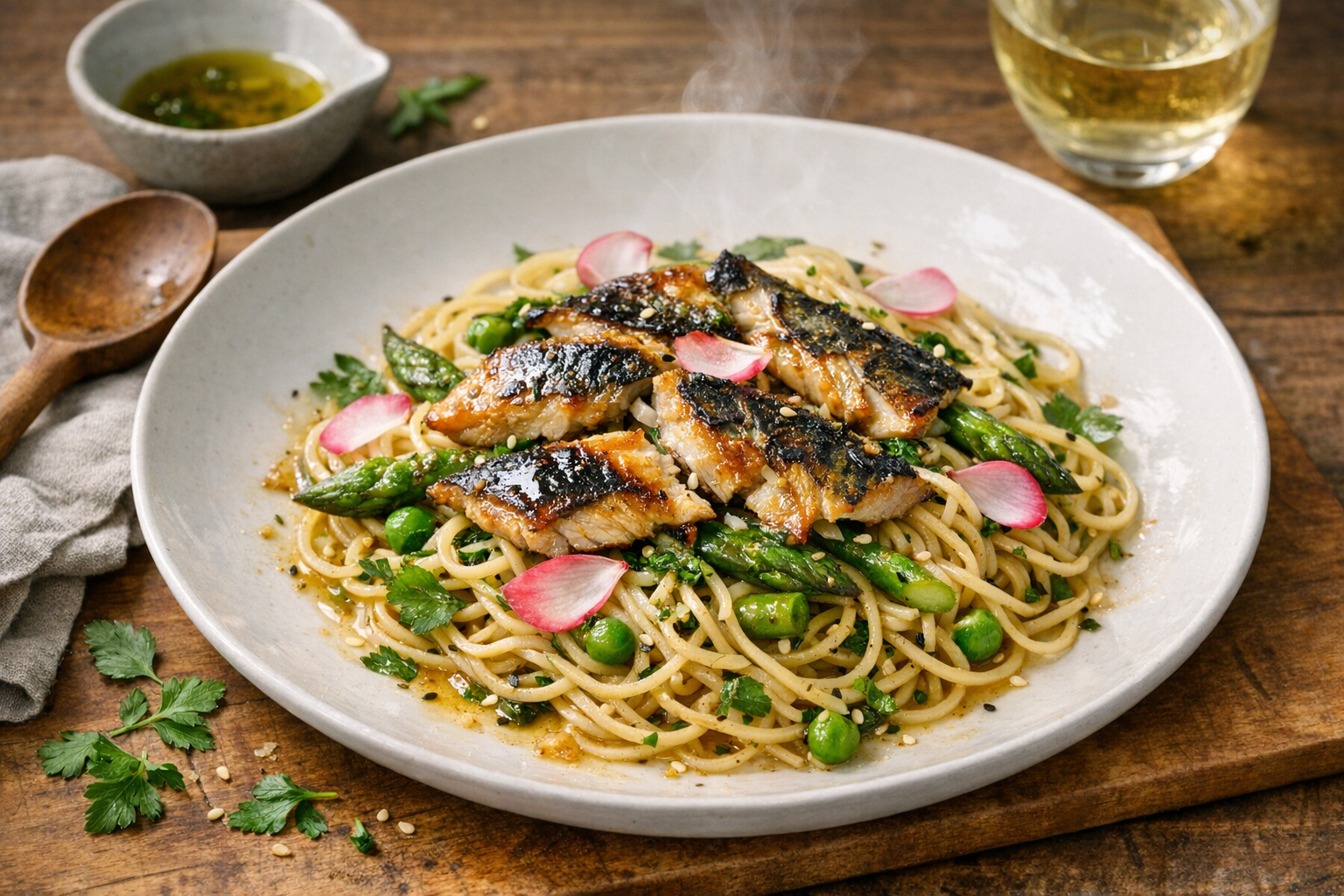
Citrus-marinated mackerel with spring herb noodles
A bright, May-ready starter: lemon-and-paprika marinated mackerel, quickly seared for crisp skin, flaked over thin egg noodles tossed with asparagus, peas, mint, and parsley.
Along Lebanon's coast, fishermen have long marinated oily fish with citrus and garlic before a fast sear, a tradition shaped by Mediterranean trade routes and Ottoman-era kitchen crosscurrents. Vermicelli-like noodles appear across the region's larders, echoing exchanges between Levantine ports and European merchants. In modern Europe, spring markets brim with asparagus, peas, and soft herbs that pair naturally with these seaside flavors. Across the Atlantic, universities have historically been crucibles for debate and cultural exchange; waves of students and scholars helped popularize portable, noodle-based salads in campus cafes throughout the 20th century. This small plate nods to those intertwined paths-coastal technique meets campus convenience-leaning on marination for depth and speed, then weaving in seasonal greens for freshness. It is meant to be shared at the start of a meal, a reminder that dialogue and foodways often travel together, even through tense times. Inspired by Residents Watch as Israeli War Planes Circle Over Southern Lebanon and Ball State Settles With Ex-Employee for $225,000 Over Charlie Kirk Posts.
Instructions
- Make the marinade base: In a medium bowl, whisk 20 ml lemon juice (from the zested lemon), lemon zest from half the lemon, 20 ml olive oil, grated garlic, paprika, chili flakes, 3/4 tsp fine sea salt, and black pepper until emulsified. Transfer 1 tbsp (15 ml) of this marinade to a small jar for the dressing and cap it; do not let it touch the fish.
- Marinate the fish: Pat the mackerel fillets dry with paper towels, then place them skin-side up in the remaining marinade. Turn to coat, ending skin-side up so the flesh is in contact with the marinade. Marinate 12-15 minutes at room temperature while you prep the vegetables. This brief marination seasons and lightly firms the flesh.
- Quick-pickle the radishes: In a small bowl, combine the reserved 10 ml lemon juice with 1/2 tsp caster sugar and 1/8 tsp fine sea salt. Add the sliced radishes, toss, and let stand 10 minutes, stirring once. Drain well before serving.
- Blanch vegetables and cook noodles: Bring a large pot of water to a rolling boil and add 1 tbsp fine sea salt. Blanch asparagus for 2 minutes, then add peas and cook 1 minute more until bright green and just tender. Use a slotted spoon to transfer veg to a colander and rinse under cold water; drain well. Return the pot to a boil, add noodles, and cook 3-4 minutes until just tender. Drain, rinse briefly under cool water to stop cooking, shake dry, then toss with 1 tsp of the 30 ml olive oil to prevent sticking.
- Mix the dressing: To the jar with reserved marinade base (which has not touched raw fish), add remaining lemon zest, the remaining 25 ml olive oil, Dijon, honey, and a pinch (about 1/8 tsp) fine sea salt. Shake until slightly thickened and glossy.
- Sear the fish: Heat a large nonstick skillet over medium-high heat for 1 minute. Lift fillets from the marinade, letting excess drip off, and pat the skin dry. Lay fillets skin-side down in the dry pan (the marinade oil is enough). Press gently for 10 seconds with a spatula so the skin makes full contact. Cook 2-3 minutes until the skin is crisp and the flesh turns opaque two-thirds of the way up. Flip and cook 30-45 seconds more, then transfer to a plate, skin-side up, and rest 3 minutes to finish with carry-over heat.
- Assemble: In a large bowl, toss noodles with asparagus, peas, spring onions, parsley, mint, and about two-thirds of the dressing. Taste and add a pinch more fine sea salt if needed. Divide among 4 shallow plates, twirling into small nests.
- Finish and serve: Flake the mackerel into large pieces, discarding any dark bloodline if present, and arrange over the noodles. Spoon the remaining dressing over the fish, top with drained radishes and toasted sesame seeds (lightly crushed between fingers as you sprinkle), and finish with 1/4 tsp flaky sea salt scattered across the plates. Serve warm-room temperature within 10 minutes for best texture.