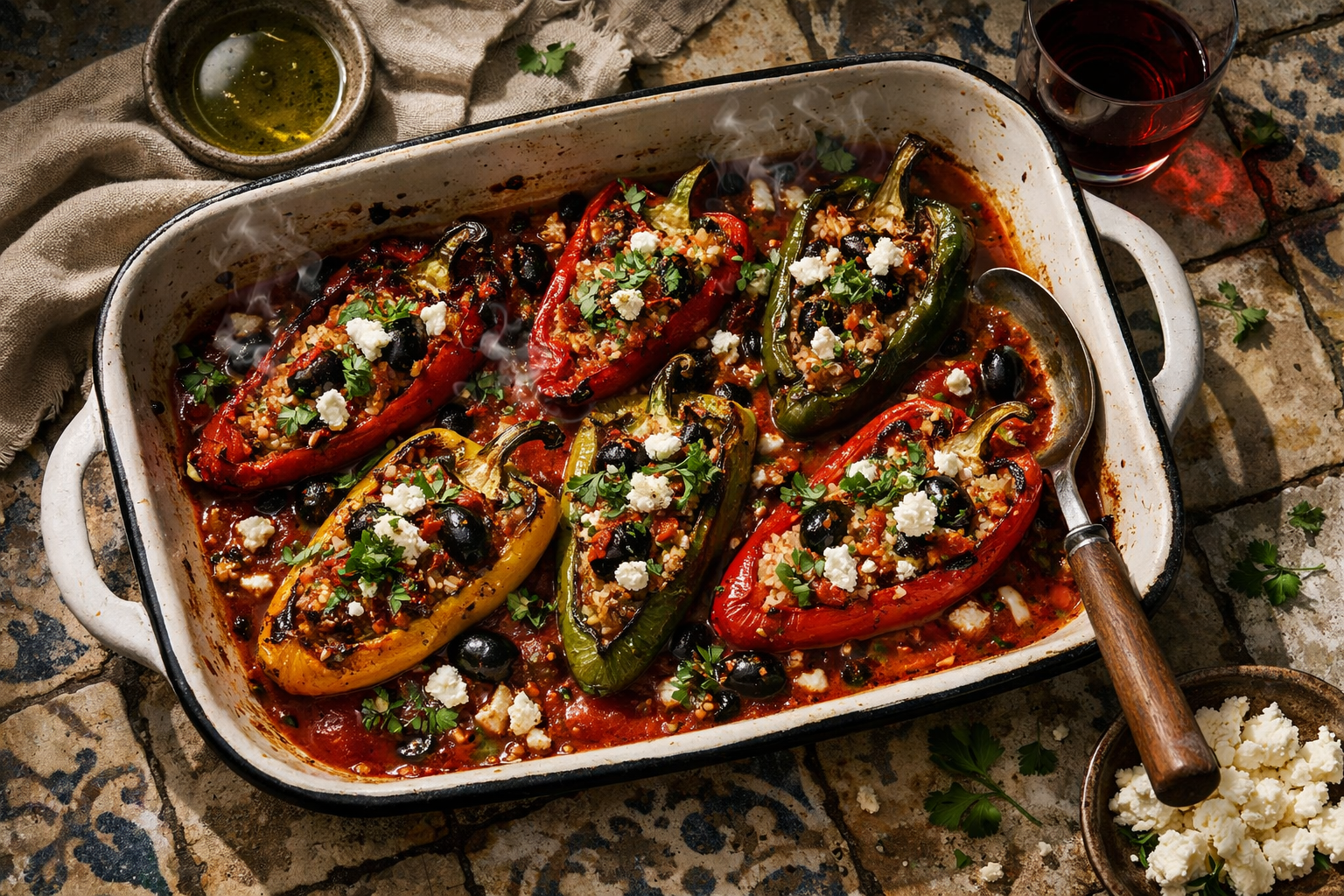
Trojan Roasted Peppers
A tray of blistered peppers, stuffed to the brim with spiced beef and farro, arrives at the table like a quiet provocation. The grains drink up tomato-olive juices; the edges char just enough to mirror the mood of a tense Sunday. It is generous, aromatic, and meant for passing around slowly, family-style.
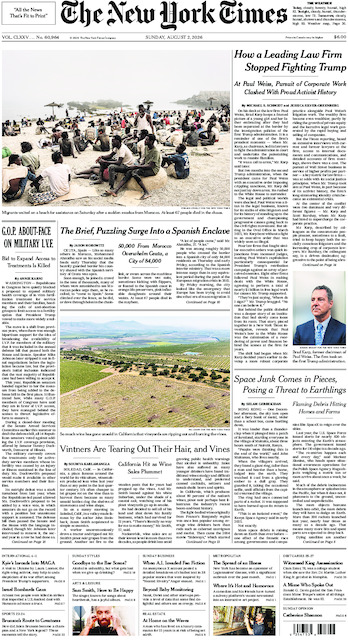
A hidden filling inside a humble shell nods to Homeric cunning: the comfort of peppers shelters a forceful core of beef and ancient grain. Farro, cultivated since antiquity around the Mediterranean, links the dish to market stalls and hearths older than any modern courthouse or cinema. The roasted, uneasy char and assertive spice gesture toward moments when public ideals shift behind closed doors, recalling how institutions can move from defiance to accommodation with surprising speed. Meanwhile, a contemporary epic retold for new audiences reminds us that old frameworks can be used to carry new messages. Here, the Trojan image is culinary: sweetness and smoke on the outside; resolve and warmth within. Served family-style, it invites debate as much as appetite, a plate where history, theater, and power share space with ripeness and juice. Inspired by How a Top Law Firm Went From Standing Up to Trump to Bending the Knee and Christopher Nolan's Trojan Horse.
To drink: Pour a Flemish red ale (Oud Bruin), whose gentle tang and malty depth balance the roasted peppers, olives, and tomato-sweet juices.
Why this dish?
Menu slot: Sunday Table
Today's draw: beef · roasting · grains (quinoa/farro) · One-pan · historical connection
Front-page mood: tense and uneasy
Why this concept: Stuffed peppers over a tomato-olive base with farro is a one-pan roast that doesn't resemble recent meatballs, noodles, enchiladas, or mustard-farro fish; the hidden filling, Greek angle, and family-style tray make it both fresh and historically resonant.
Drawn from:
- How a Top Law Firm Went From Standing Up to Trump to Bending the Knee
- Christopher Nolan’s Trojan Horse
Instructions
- Heat oven to 200C with a rack in the middle. Use a large ovenproof skillet (35-40 cm) for both stovetop and oven; alternatively, do stovetop steps in a skillet and transfer to a 33×23 cm roasting pan for baking (use two pans if needed to fit the peppers).
- Mise en place: Halve and deseed the peppers; finely dice the onion; finely chop the garlic; coarsely grate the tomatoes with their juices; halve the olives; chop the parsley; warm the stock; pat the beef dry.
- Rub the pepper halves with 10 ml oil and 1 g of the salt; set aside cut side up.
- Set the pan over medium-high heat. Add 20 ml oil, then the onion and 1 g of the salt. Cook, stirring, until translucent and lightly golden at the edges, 6-8 minutes. Add the garlic and cook 30 seconds until fragrant.
- Add the beef and the 1 g black pepper, breaking it up with a spoon. Sprinkle in 2 g of the salt. Cook until no visible pink remains and moisture has mostly evaporated, 5-6 minutes.
- Stir in the cumin, smoked paprika, dried oregano, and tomato paste along with 1 g of the salt; cook 1 minute to toast, until the paste darkens slightly and smells sweet.
- Add the rinsed farro and cook 1 minute, stirring, until glossy and coated.
- Pour in 300 ml hot stock. Bring to a lively simmer and cook, stirring occasionally, until most liquid is absorbed and the farro has begun to swell but is still quite firm, 8 minutes. Scrape the beef-farro mixture into a bowl (it will finish cooking in the oven).
- Return the pan to medium heat. Add the grated tomatoes, olives, remaining 200 ml stock, red wine vinegar, remaining 15 ml oil, and the last 2 g of salt. Simmer 2 minutes, scraping up any browned bits, until the sauce looks cohesive.
- Nestle the pepper halves, cut side up, into the sauce. Spoon the beef-farro mixture into each pepper, mounding it slightly. Spoon a little sauce around the peppers (not over the tops) so the grains can drink from below.
- Cover the pan tightly with foil and roast 25 minutes. Uncover and roast 10-15 minutes more, until the pepper edges are blistered, the sauce is thick and bubbling, the farro is tender, and an instant-read thermometer inserted into the center of a pepper registers at least 71C.
- Rest 10 minutes out of the oven so the grains settle and carryover heat evens out. Scatter with feta and parsley. Spoon the tomato-olive juices over the peppers and serve family-style from the pan.
Cook's note
Pearled farro cooks fastest; semi-pearled may need 5 more minutes under foil. For gluten-free, swap 200 g quinoa, reduce stock to 350 ml, and check doneness 10 minutes earlier. If your peppers are very thick-walled, add 50 ml extra stock to the sauce and roast 5 minutes longer. Leftovers should be reheated until the center reaches 74C. A brief 2-3 minute broil at the end intensifies blistering if your oven runs cool.