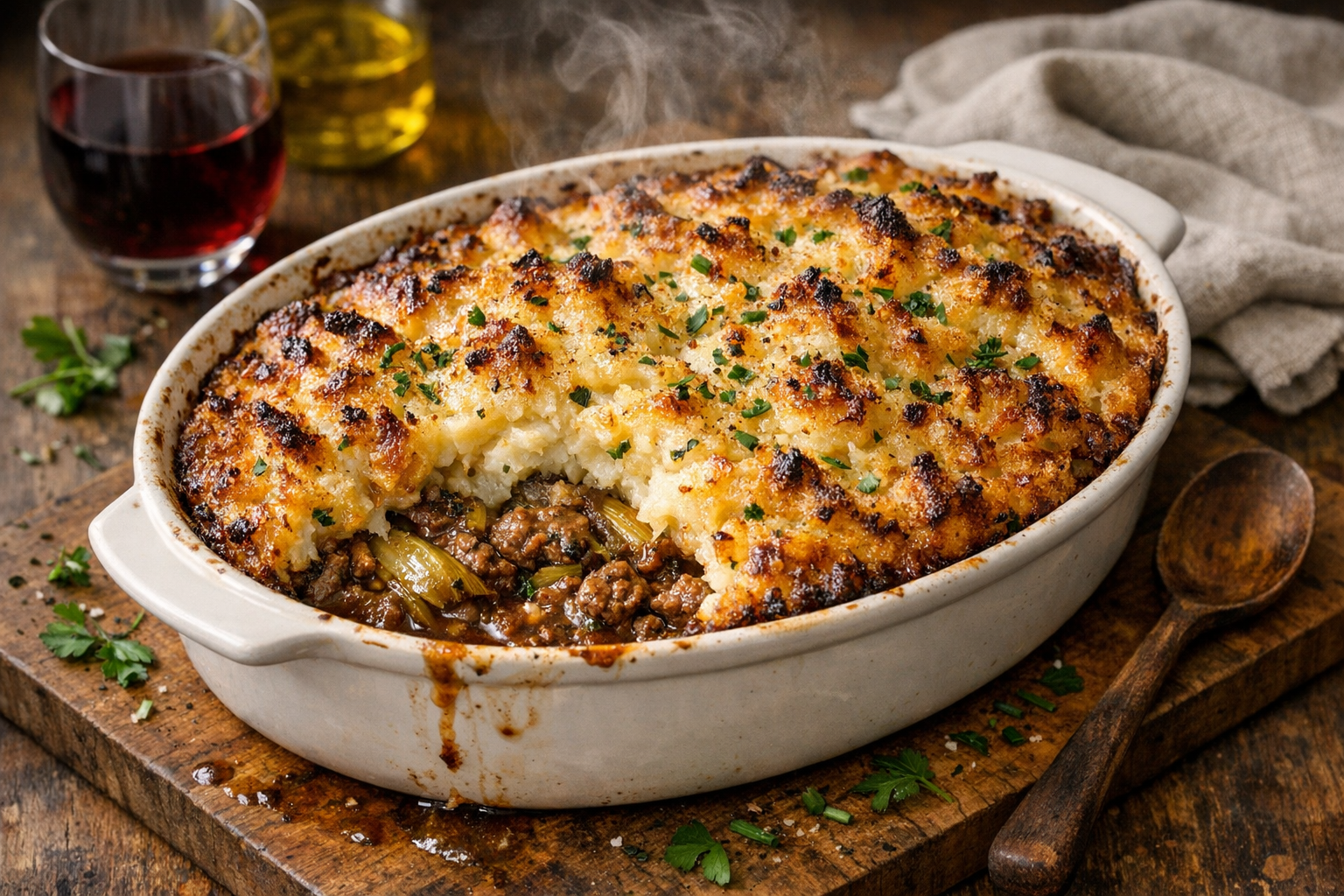
Baked Belgian Cottage Pie with Leeks, Endive and Mustard-Mash (Stoemp Style)
A crisp-topped cottage pie meets Belgian stoemp: buttery mustard-scented mashed potatoes blanket a savory beef, leek and endive filling, finished in the oven until bubbling and deeply golden. It's weeknight-friendly, uses April produce you'll find anywhere, and leans on the oven for even heat and hands-off time.
Cottage pie emerged in late-18th-century Britain as potatoes became affordable, a thrifty way to stretch meat with roots and alliums. Belgium's stoemp-mashed potatoes folded with leeks or endive-similarly speaks to frugal comfort. During Europe's 1970s energy crunch, and earlier wartime rationing, households favored efficient one-dish bakes that made a little beef go further while the oven did steady work. Today's high household bills and debates over fuel and security echo those eras; a compact bake like this nods to that history without skimping on pleasure. Ground beef is bolstered by leeks, carrot, and Belgian endive, brightened with Dijon and a splash of vinegar, then capped with rough-peaked mash that browns beautifully-an economical, resilient technique with deep roots on both sides of the Atlantic. Inspired by Debt Alarms Ring as Countries Rack Up More Emergency Spending and Trump's Go-To Justification for Contentious Decisions: National Security.
Instructions
- Heat the oven to 200b-C/400b-F (fan off). Place a rack in the upper-middle position and set a 2.5 to 3 liter ovenproof dish or a 28 cm ovenproof skillet on a sheet tray to catch drips.
- Start the potatoes: Put the potatoes in a large pot, cover by 2 cm with cold water, and add the coarse sea salt (12 g). Bring to a boil over high heat, then reduce to a lively simmer and cook until a fork slides in easily, 12-15 minutes. Drain well, return to the hot pot, and let steam-dry over low heat for 2-3 minutes, shaking occasionally; remove from heat and cover to keep warm.
- While the potatoes cook, make the filling: Heat the olive oil in a large skillet over medium-high. Add the beef, ¾ tsp fine sea salt and ½ tsp black pepper. Cook, breaking it up, until well browned with crisp edges and fond forms on the pan, 4-5 minutes. Spoon off excess fat, leaving about 1 tbsp in the pan.
- Reduce heat to medium, add 10 g butter, then the leeks, carrot, endive and thyme. Cook, stirring, until leeks are soft and the endive edges look lightly caramelized, 5-6 minutes.
- Sprinkle in the flour; cook 1 minute, stirring, then add the tomato paste and cook until it darkens slightly and smells sweet, about 1 minute. Stir in the beef stock, Worcestershire and bay leaf. Simmer, scraping up browned bits, until glossy and spoonable, 5-6 minutes. Stir in the peas, red wine vinegar, and ½ tsp fine sea salt plus ¼ tsp black pepper. Remove from heat; fish out and discard the bay leaf.
- Mash the potatoes: Warm the milk if needed. To the hot potatoes, add 50 g butter, the warm milk, Dijon, nutmeg, ¾ tsp fine sea salt and ¼ tsp black pepper. Mash until smooth and fluffy, then fold in the parsley. The mash should hold soft peaks; add a splash more milk if stiff.
- Assemble: Spread the beef-vegetable mixture evenly in the baking dish. Spoon the mash over the top in dollops, then gently spread to the edges without pressing down; use a fork to create rough peaks for better browning. Sprinkle with Gruyère and dot with the remaining 10 g butter.
- Bake until the filling bubbles at the edges and the potato peaks are deeply golden, 18-22 minutes. For extra color, switch to grill/broil on high for 1-2 minutes, watching closely.
- Rest 10 minutes to let the filling settle and carry-over heat finish thickening. Scatter with chives and serve hot, ideally with a crisp green salad alongside.