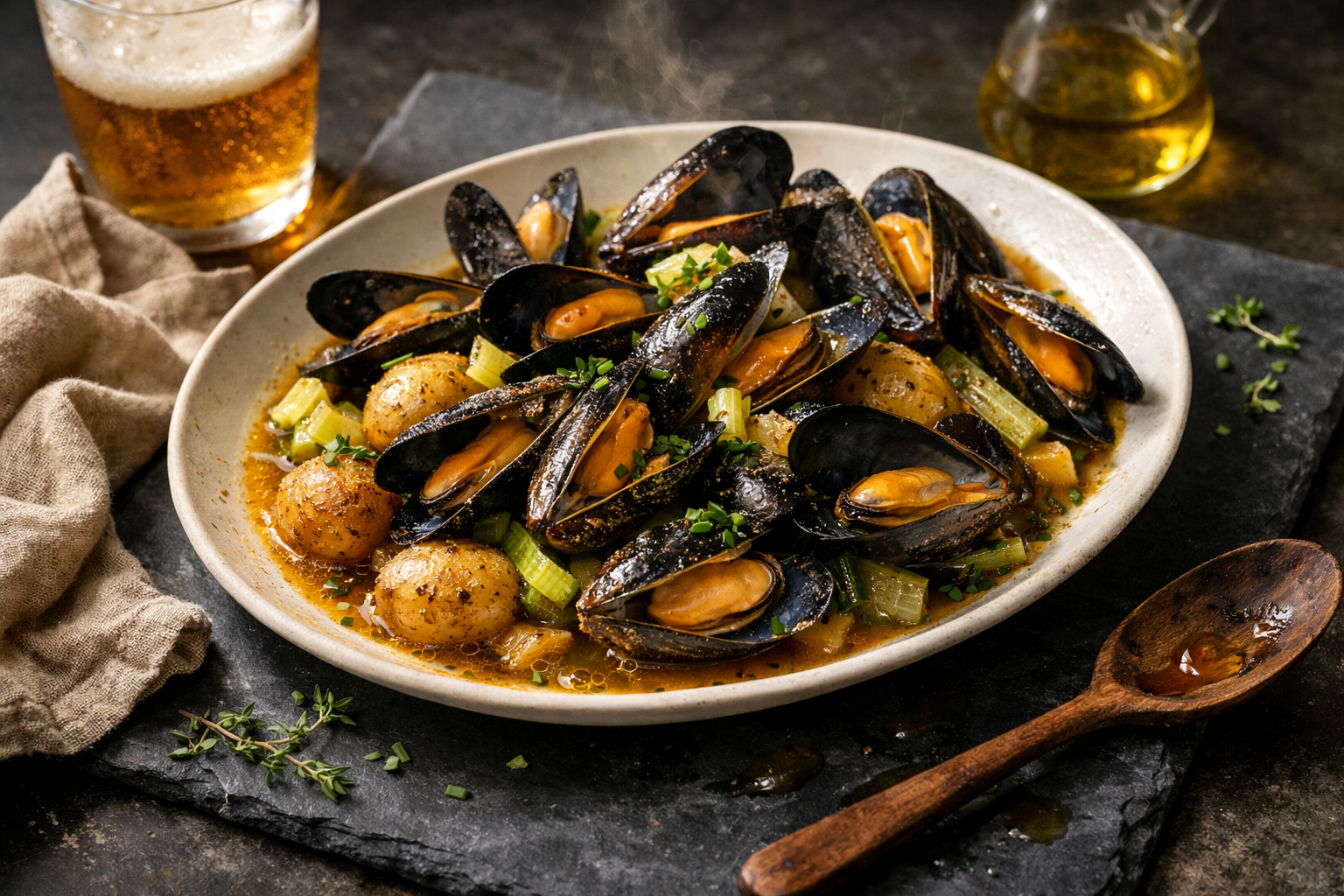
Mussels in Belgian Ale
A quiet, generous pot of mussels and potatoes, built on simple discipline: clean aromatics, steady heat, and a broth you want to ladle twice. July's North Sea mussels meet Belgian ale and leeks, then pour over wrinkled, buttery salt potatoes in a family-style dish that invites everyone to the table. It is comforting without flourish, the kind of Sunday cooking that holds the room steady.
Mussels in Belgium are summer ritual, often steamed with beer, leeks, and celery in kitchens not far from ports and, lately, the anonymous concrete shells of server halls. Across the Atlantic, Syracuse built its own legend from brine, where workers once boiled small potatoes in intensely salty Onondaga Lake water that crusted their skins and concentrated their sweetness. This platter braids those threads: a sober, industrial poetry, grounded in regions that know factories, freight lines, and the long game of organization, from Buffalo to the Low Countries. The mussel pot nods to moules cooked with ale; the base borrows Syracuse's startlingly simple technique. Everything lands family-style, with wrinkled potatoes catching an amber broth scented by leek and thyme. It feels right for a tense season: modest, purposeful, and quietly abundant. Inspired by How a Gang of Thieves Pulled Off a Multimillion-Dollar Data Center Heist and The Democratic Socialists Winning Elections Far From New York City.
To drink: Pour a chilled Belgian saison; its peppery, dry finish lifts the sweet mussels and buttery potatoes.
Why this dish?
Menu slot: Sunday Table
Today's draw: shellfish · steaming · potatoes · Main · geographical connection
Front-page mood: tense and sobering
Why this concept: A beer-broth mussel steam over Syracuse salt potatoes is a classic, generous pot-and-platter format unlike any recent grain- or yogurt-driven dishes; its flavor is malty, briny, and herbaceous (not lemon-forward), and the geographic tie (Belgium/Zeeland + Syracuse salt heritage) is clear and fresh.
Drawn from:
- How a Gang of Thieves Pulled Off a Multimillion-Dollar Data Center Heist
- The Democratic Socialists Winning Elections Far From New York City

Instructions
- Mise en place: Rinse the mussels under cold running water, discard any with cracked shells, and pull away beards. Tap open mussels; if they do not close, discard. Keep chilled. Slice and rinse the leek to remove all grit; finely dice celery and shallots; slice the garlic.
- Start the salt potatoes: In a large pot, combine 2000 ml cold water and 220 g fine sea salt. Bring to a boil over medium-high heat, stirring until the salt dissolves. Add the potatoes, return to a strong simmer, then cook uncovered at medium-high heat until tender when pierced, 20-25 minutes. The skins will wrinkle and look slightly chalky from the brine.
- While the potatoes cook, set a wide Dutch oven (or deep saute pan with a tight lid) over medium heat. Add 40 g butter and, when melted and foaming, add the shallots, celery, and leek with 2 g of the remaining salt. Cook, stirring, until glossy and lightly softened without color, 5-6 minutes. Add the garlic and cook 30 seconds until fragrant.
- Stir in the Dijon mustard, then pour in the ale and white wine vinegar. Add the bay leaf and thyme. Increase heat to high and bring to a boil; let it bubble 1 minute to build steam.
- Steam the mussels: Add the mussels to the pot, toss quickly to coat, then clamp on the lid. Cook over high heat, shaking the pot once or twice, until most shells just pop open, 5-7 minutes. Remove from heat, uncover briefly to release excess steam, then cover again and let stand off the heat 1-2 minutes for carryover cooking to finish opening stragglers. Discard any that remain closed.
- Finish the broth: Stir in the remaining 1 g salt and the black pepper. Taste; the broth should be bright, lightly bitter from the ale, and well seasoned. Fish out and discard the bay leaf and thyme sprigs.
- Finish the potatoes: Drain well and let the potatoes rest in the empty hot pot, uncovered, 5 minutes to dry and set their salt crust. Add 60 g butter, cut into small cubes, to the hot pot; swirl until melted, then roll gently to coat. Keep warm.
- Serve family-style: Spread the potatoes on a warmed shallow platter. Spoon the mussels and vegetables over the top, then ladle on plenty of the hot broth. Scatter with chives and bring to the table immediately.
Cook's note
Choose small, even-sized potatoes (3-4 cm) so they cook uniformly. If your ale is quite bitter, swap in a Belgian blonde or an alcohol-free lager. Keep the mussels in a colander over ice while you prep to hold them at safe temperature. Leftovers can be reheated gently in the broth to 74C; do not reheat twice.